Source B - Video 'Agent Orange (Australian Army)', 2018. Graham Walker. (here)
Source B is a secondary source, and a recording of an Australian Army veteran, Graham Walker, speaking about his experience with the effects of Agent Orange on Australian veterans. It was originally published in June of 2018, by the Department of Veterans' Affairs. Source B is a part of a series of 32 short films, commissioned as a part of the Australian Government’s commitment to further develop the Vietnam Veteran’s Education Center, an interactive memorial at the National Mall in Washington, DC. The films were created to be an accessible resource for not only Australians, but the general public of America, including tourists visiting the VVEC. The filmed interviews were conducted with the intention of reflecting the overall experience of ANZAC veterans, and part of that was their interactions with Agent Orange. Walker explains that, initially, there were no systems in place to support Australian veterans who suffered from the negative effects of the infamous herbicide. Walker, along with the Vietnam Veterans’ Association of Australia (VVAA), pushed for the legal acknowledgement of cancer as a long-term side effect of the war. “Vietnam veterans were seen as angry,” Walker said. “We're probably no more angry than people from any other war, but we expressed it publicly, and didn't resile from harsh criticism of whoever we felt should be criticised and that included governments and bureaucrats and anybody.” Source B is symbolic of how hard Australian veterans had to struggle for recognition and support in their own country, long after the war ended.
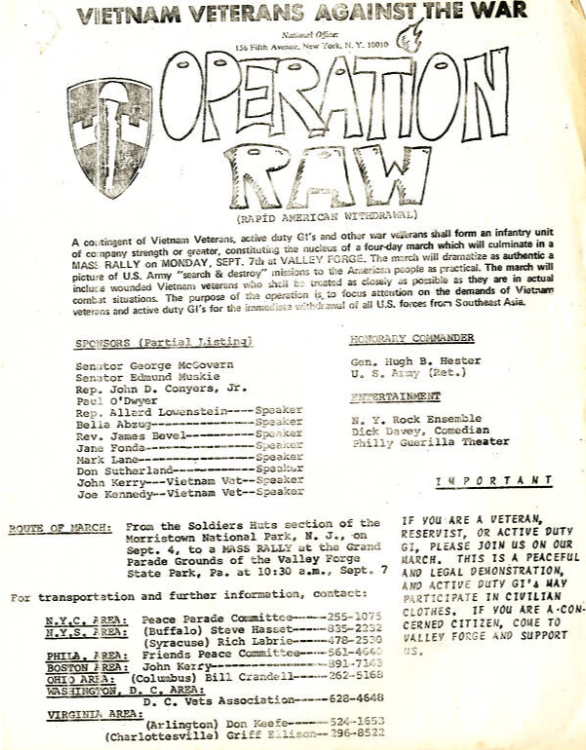
Source A - Operation RAW poster, 1970. Distributed by the VVAW. (here)
Source A is a primary source; a flyer outlining Operation RAW (Rapid American Withdrawal). Operation RAW was a 4-day-long march held between September 4–7, 1970, pushing for the immediate removal of all American soldiers in vietnam. The demonstration was designed to create a dramatised replica of the search-and-destroy missions taking place in Vietnam. The protestors made sweeps of towns they passed through, took and interrogated civilians, seized property, and cleared homes. This was done with the help of guerrilla actors posing as members of the general public. The route of the march was around 140km, and concluded in a rally attended by over 1,500 people. Source A was produced with the intention of event publicity and mobilisation, distributed in America by the organisation running the protest, the Vietnam Veterans Against the War (VVAW). It’s an informational poster aimed towards the general public, as well as both veteran and active duty GIs. The tone is straightforward, explaining that it was both a peaceful and legal demonstration that aimed to bring light to the demands of the VAW. Source A is an example of how negatively veterans from Vietnam were affected by the conflict, going as far as to protest the continuation of American military involvement when they returned home.
Source C - 'Why Were Vietnam War Vets Treated Poorly When They Returned?' 2018, Dante A. Ciampaglia (here)
Source C is an article that discusses the way that American veterans were treated upon their return from the war. It was originally published in 2018 by A&E Television Networks, LLC. It was written by Dante A. Ciampaglia for the website ‘HISTORY’, in order to explain the story of American Vietnam war veterans to interested members of the public. The article uses quotes, photographic references, and socio-political context to bring light to the way that Vietnamese veterans have been treated in America. The article takes the perspective of the veterans in order to help the reader sympathise with the soldiers’ stories. Source C is descriptive, with a strong bias towards the veterans, and it's a secondary source, but it uses many primary sources to make its case, and gives a good overview of the way that many Americans were treated when they returned home from the war. “They were not necessarily looking for a parade, but they were certainly looking for basic human support and help in readjusting to civilian life after this really brutal war.” Source C is a valuable source to consider when learning about the struggles Vietnamese veterans faced after the initial conflict.
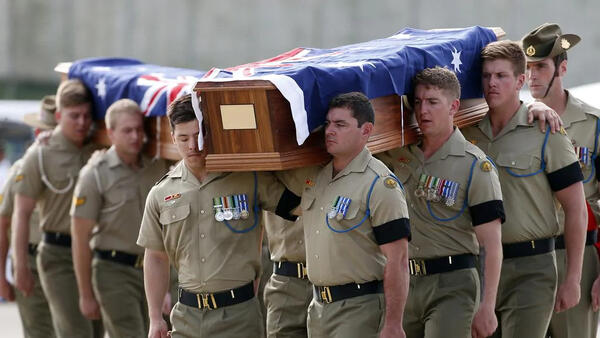
Source D - Australian military personnel carry coffins of Vietnam war veterans, 2016. Photographer unknown. (here)
Source D is a photograph of Australian military personnel as they carry the coffins of 22 Vietnam war veterans upon their return to their homeland. Source D was captured at a ceremony in Townsville in 2016, to be later published in the Townsville Billboard, alongside this article. The photograph was taken in order to memorialise the occasion, as supported by this quote from the article - “For every Australian, this will be an opportunity to acknowledge the sacrifice of all those who have died.” Source D is an important reminder to the public and the families of those affected by the Vietnam war, and it’s symbolic of the long-lasting effects of the war itself. Bring one of the largest, single military repatriations in Australia’s history, this photograph carries a lot of weight, and represents the return of veterans to their home after 50 years in foreign soil. Source D is a valuable source when considering how long term the effects of the Vietnam war really are, and demonstrates how there are still many Australian veterans and families who suffer to this day.
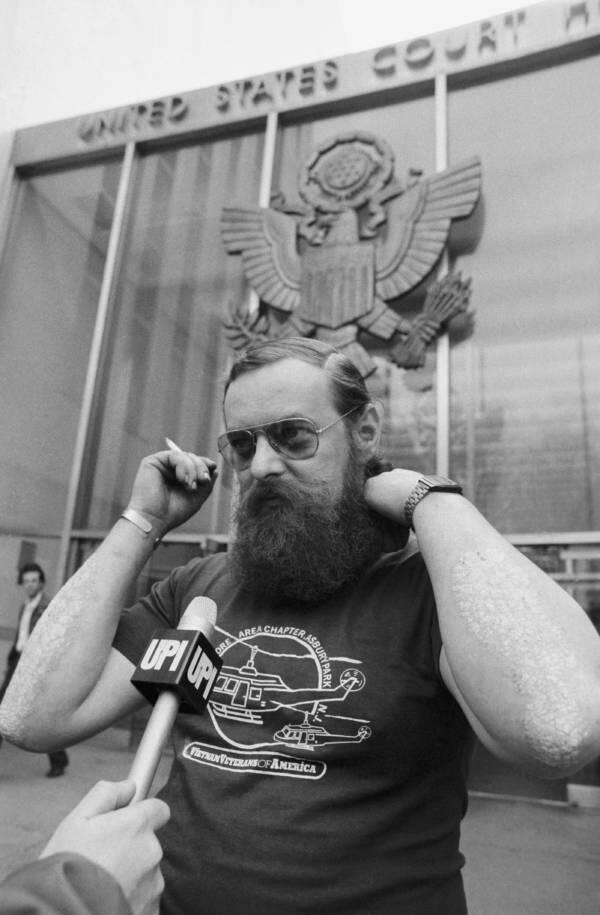
Source E - American veteran James Burdge, 1984, Brooklyn. Distributed by Bettmann/Getty images. (here)
Source E is a photograph of American veteran James Burdge suffering from the lifelong effects of working with Agent Orange, courtesy of Bettmann/Getty Images.. The photograph shows him as he stands outside of Brooklyn Federal Court in 1984. Under his clothing, the rashes on his arms cover half his body. The media was a huge part of the vietnam war, and this was just one of the thousands and thousands of images taken by photographers to be used by miscellaneous news and journalist publications. Photos like these were often seen by many, and rely on the audience to draw their own conclusions from the images. Source E depicts Burdge looking directly at an out-of-frame reporter accompanying the composer of the photograph - the only indication that they’re there is the hand and microphone still in frame. It’s an incredibly powerful photograph, with Burdge’s glare feeling fed-up and accusing. Source E is a perfect example of the anger that many Vietnam war veterans felt, the same anger that was often scorned by the public, and represents both the physical and psychological torture that veterans experienced long after they had returned home.
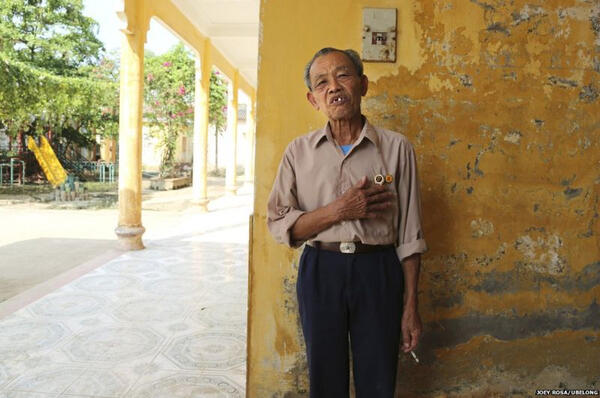
Source F - Luong Ngoc Lam photographed at Friendship Village, 2015. Joey Rosa for UBELONG. (here)
Source F is a photograph of North Vietnamese war veteran, Luong Ngoc Lam, as he stands in front of Friendship Village, a shelter for veterans and children affected by Agent Orange. He served as a field soldier for the NVA from 1966 to 1975. It was taken in 2015 and presented in a BBC ‘In Pictures’ article, curated by Phil Coomes. The article is a memorial to the veterans of North Vietnam, a side not often taken into consideration in english media. It’s a respectful article that aims to display the humanity of the North Vietnamese soldiers, helping the western world to sympathise and understand the repercussions the war had on the other side. "When the war ended, I had not seen my wife in 10 years," Luong Ngoc Lam said. "I returned home to learn that she had held 10 funerals during that period, including one for my younger brother. Coming home to learn that he had been killed was devastating.” Source F is an often hard-to-find example of the pain that North Vietnamese veterans experienced following the war, evoking compassion and empathy in the viewer, helping to create a deeper understanding of the true extent of the effects on all veterans, not only US allied forces.
My choice of topic and why, as well as what I learned from this project
For my topic, I chose Vietnam war veterans, exploring perspectives from America, Australia, and North America. More specifically, I chose to focus on problems the veterans had to deal with as a result of the war - whether that was battling physical disability, psychological trauma, fighting for the just treatment of other veterans, or protesting the continued military involvement in the vietnam war. I picked this topic because I thought I would be able to get a really wide range of sources, allowing myself to learn as much as possible about these Vietnam veterans, and curating an interesting and varied display of sources. I’ve chosen to display my findings in website format, as I believe it is the most accessible way for viewers to interact with the information I’ve collected, as well as further reading being only a click away. Creating a website is also something that I have an interest in, and something that I knew I would be confident doing. Through this project, I’ve learnt a lot about the impact of the Vietnam war, especially for veterans and their families. One of the big things I was surprised about was the extent of the impacts of Agent Orange - I knew about its second and even third-generation effects, but the impacts of the herbicide on the soldiers that experienced it first-hand is often overlooked. And it was not only North Vietnamese soldiers who suffered; many of the western soldiers who deployed the chemicals struggled with long lasting effects as well, such as cancers and skin conditions. I was also surprised at how hard many veterans had to struggle for both societal and political support, as when many of the soldiers returned home, the war they had just been fighting in had become incredibly unpopular. Overall I enjoyed the project, and was able to really expand my understanding of the longer-lasting effects of the Vietnam War.-- Louise